Fashion Context
Written and Designed by Eden Harvey

For my exhibition visit, I explored the wonders of Norwich Castle Museum. The museum leads you through many different exhibition sections, including a natural history gallery, an art gallery and a Celtic and Roman history gallery. Despite the wide range of intriguing galleries this museum holds, the one that stood out the most to me was the Fashion and Textiles exhibition. This exhibition takes you on an educational and visual journey through all the different garments, fabrics, production techniques and textiles from each century, from the 1400’s to the recent 2000s.
The era I found the most interest in was the Gothic style of the 15th century. The Gothic style originated in France in the mid 12th century and in many forms lasted around 250 years. It was characterised by slender, pointed forms, with elongated curves. There was an emphasis on vertical lines which carried the eye upwards. The Gothic style developed first in architecture, but was later seen in painting, sculpture, stained glass and manuscripts. By the early
Embroidered Panel, probably Norfolk, c.1750


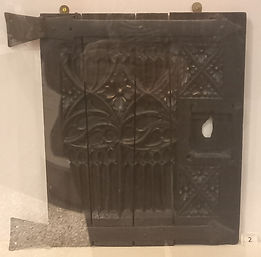
15th century, the Gothic style had become international and was seen throughout Europe. St Peter Mancroft church is one of the best surviving examples of the later Gothic style in Norwich.
Portion of Altarpiece, walnut or lime wood, Brussels, on loan from St Margarets Church, Old Catton, Norwich, 1470s
Trefoil Roof Bosses, gilded wood, probably Norfolk, 15th century
Tabernacle Door, oak, probably Norfolk, 15th century
When it comes to the textiles and dresses of the 15th century, very few textiles survived intact from this period. What we know about what people wore during this era comes mainly from paintings, sculptures, or memorial brasses. During the 15th century, people gained an increased understanding of tailoring and pattern cutting and were able to produce garments which fitted more closely to the body. Dresses were made to emphasise the waist and flare out over the hips, and a very long, trailing dress was a symbol of the status of the wearer, indicating that the wearer did not have to do physical work. Men wore gowns, short tunics and fitted cloth leggings, and children wore small versions of adult garments. Poor people often spun their own wool at home and dressed on course wool and linens, while royalty and nobility wore imported, expensive dyed silks and velvets.

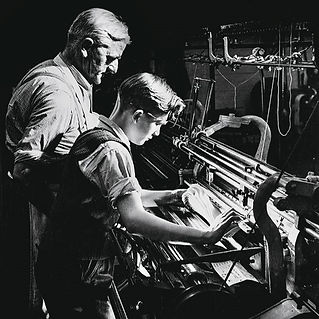
Photography by Walter Nurnberg
The section of the museum I liked the least (but still found interesting) was The Industrial Photography of Walter Nurnberg and Rita Nurnberg exhibition, curated by Dr Nick Warr and Dr Simon Dell with Elizabeth Elmore. Walter and Rita Nurnberg were photographers who were seeking to establish a new image of British industry by adapting techniques pioneered by an interwar generation of European artists, and between 1948 and 1961 they made dramatic photographs of the factories of Norwich and their workers.
Despite every exhibition of Norwich Castle Museum being largely interesting and beautiful, this specific one was vastly overpowered by writing and supported by black and white photography, which is expected considering this photography was taken almost 100 years ago, but it made it hard for me to grasp an interest on what I was learning. I personally don’t have a curiosity for industrial photography, which is another factor as to why this exhibition, especially compared to the Fashion and Textiles exhibition, was the least fascinating to me.